Contents
- 1 What are candlestick patterns in Forex?
- 1.1 Introduction to Candlestick Patterns in Forex
- 1.2 . What Is a Candlestick in Forex Trading?
- 1.3 History and Origin of Candlestick Charts
- 1.4 Why Candlestick Patterns Matter for Forex Traders
- 1.5 Basic Candlestick Formations Explained
- 1.6 Top 10 Most Powerful Candlestick Patterns in Forex
- 1.7 How to Use Candlestick Pattern for Trading Strategies
- 1.8 Common Mistakes to Avoid When Using Candlestick Patterns
- 1.9 Tips for Beginners to Improve Candlestick Reading Skills
- 1.10 Psychology Behind Candlestick Patterns
- 1.11 How to Confirm Candlestick Signals
- 1.12 . Time Frames That Work Best
- 1.13 Candlestick Patterns in Different Markets
- 1.14 Common Myths About Candlestick Patterns
- 1.15 🔹 Best Tools for Analyzing Candlestick Charts
- 1.16 🔹Candlestick Patterns Cheat Sheet (Visual Idea)
- 1.17 Understanding Market Rhythm Through Candlesticks
- 1.18 Combining Patterns with Technical Tools
- 1.19 The Role of Market Context
- 1.20 Enhancing Trading Psychology
- 1.21 Candlestick Patterns Across Different Markets
- 1.22 Identifying Key Support and Resistance Levels
- 1.23 The Importance of Volume in Candlestick Analysis
- 1.24 Common Mistakes Traders Make with Candlestick Patterns
- 1.25 Developing a Consistent Trading Routine
- 1.26 Combining Candlestick Patterns with Technical Indicators
- 1.27 Using Multiple Time Frames for Confirmation
- 1.28 Advanced Risk Management Strategies with Candlesticks
- 1.29 Tips for Practicing and Mastering Candlestick Patterns
- 1.30 The Role of Market News in Candlestick Analysis
- 1.31 Final Thoughts and Next Steps
- 2 Take Your First Step Today
- 3 How to Open Your Exness Account
What are candlestick patterns in Forex?
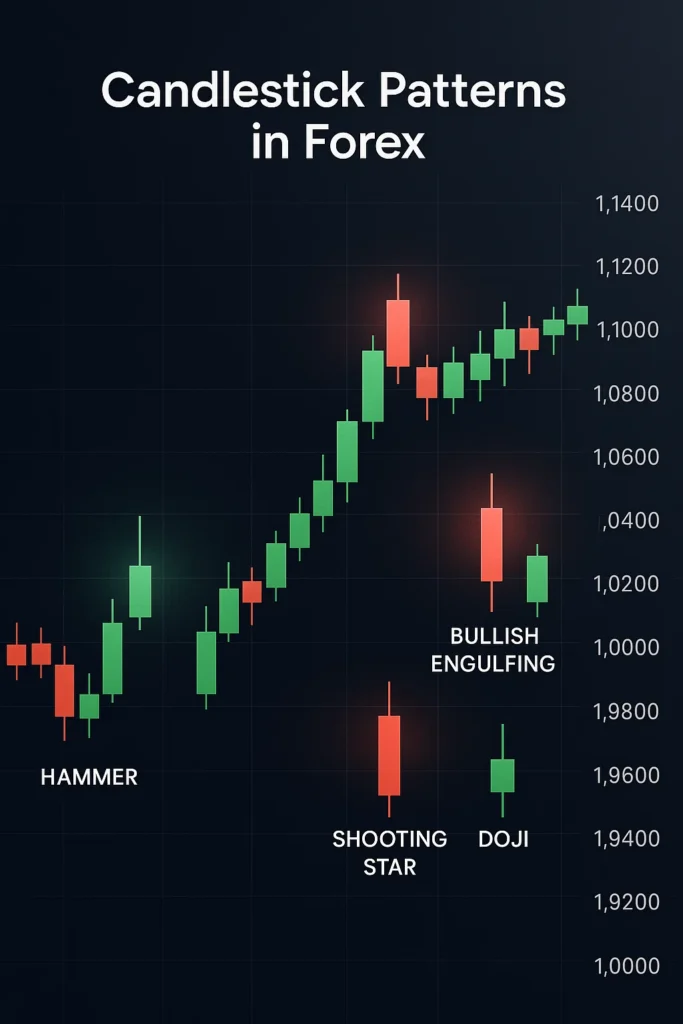
Introduction to Candlestick Patterns in Forex
In the fast-moving world of Forex, understanding candlestick patterns is one of the most valuable skills you can gain. A candlestick chart offers a visual map of market activity—revealing who’s winning the battle between buyers and sellers at any given time.
Traders use candlestick patterns in Forex to recognize market trends, predict price reversals, and find entry and exit points with greater confidence. Whether you’re a beginner exploring your first Forex candlestick chart or an experienced trader refining your price-action strategy, mastering candlesticks can significantly improve your trading decisions.
This comprehensive guide to candlestick patterns in Forex will show you the basics, the most powerful patterns, and practical ways to use them to build profitable trading strategies.
. What Is a Candlestick in Forex Trading?
A candlestick is a graphical price bar used in technical analysis to display four critical data points for a specific period: the opening, closing, highest, and lowest prices of a currency pair.
Each candlestick has three key components:
Body: The rectangular portion that shows the difference between the opening and closing prices.
Wicks (Shadows): Thin lines above and below the body indicating the highest and lowest traded prices.
Color:
A green (or white) candlestick means the price closed higher than it opened → bullish.
A red (or black) candlestick means the price closed lower than it opened → bearish.
Unlike line charts that show only closing prices, a Forex candlestick chart provides more detail about market sentiment and momentum.
By interpreting candlesticks correctly, traders can recognize whether buyers (bulls) or sellers (bears) are controlling the market, which is essential for making informed trading decisions.
History and Origin of Candlestick Charts
Candlestick patterns date back to 18th-century Japan, when a rice trader named Munehisa Homma developed them to track rice prices. Homma discovered that certain candle formations reflected human psychology—fear, greed, and indecision—allowing him to predict price changes more accurately.
These insights later influenced modern technical analysis. Today, candlestick charts are a universal tool in Forex trading, equities, and crypto markets, proving their effectiveness in capturing real-time price action.
Why Candlestick Patterns Matter for Forex Traders
Learning candlestick patterns in Forex trading gives you an edge by revealing:
Trends: Is the market bullish, bearish, or ranging?
Reversals: Signs that the price is about to change direction.
Market Sentiment: Whether buyers or sellers dominate.
Entry & Exit Points: Ideal positions to enter or exit trades.
In fast-moving Forex markets, price can shift in seconds. Relying on indicators alone often delays decision-making. Candlestick patterns provide immediate insight into the ongoing battle between bulls and bears—helping traders spot profitable opportunities faster.
Basic Candlestick Formations Explained
Before analyzing complex patterns, let’s look at the most common single-candle formations:
🔹 Essential Candlestick Types
Bullish Candle: A large green candle signals strong buying pressure.
Bearish Candle: A large red candle indicates strong selling pressure.
Doji Candle: A candle with little to no body shows market indecision.
Spinning Top: A small body with long wicks suggests low momentum and potential reversal.
🔹 Wick Analysis
Long Upper Wick: Buyers pushed prices up, but sellers regained control → potential bearish sign.
Long Lower Wick: Sellers pushed prices down, but buyers fought back → potential bullish signal.
Understanding these single-candle formations builds the foundation for identifying full candlestick patterns in Forex.
Top 10 Most Powerful Candlestick Patterns in Forex
🔥 Bullish Reversal Patterns
Hammer:
Small body, long lower wick.
Appears after a downtrend → signals price may rise.
Bullish Engulfing:
Large green candle completely engulfs the previous red candle.
Indicates strong buying momentum.
Morning Star:
A three-candle pattern: red → small indecision → strong green.
Shows the end of a bearish trend and start of bullish momentum.
Piercing Line:
Green candle closes above the midpoint of the previous red candle.
Suggests potential trend reversal upward.
🔥 Bearish Reversal Patterns
Shooting Star:
Small body with a long upper wick.
Appears after an uptrend → suggests weakening upward momentum.
Bearish Engulfing:
Large red candle engulfs the previous green candle.
Signals sellers are in control.
Evening Star:
Opposite of Morning Star → predicts downward reversal.
Hanging Man:
Similar shape to Hammer but occurs after an uptrend → bearish signal.
🔥 Continuation Patterns
Three White Soldiers:
Three consecutive bullish candles → strong upward continuation.
Three Black Crows:
Three consecutive bearish candles → strong downward continuation.
When applied with proper candlestick chart analysis, these patterns help traders identify profitable trading opportunities.
How to Use Candlestick Pattern for Trading Strategies
Follow these steps to incorporate candlestick patterns into your Forex strategies:
Identify the Overall Trend: Patterns work best when aligned with broader trends.
Combine with Indicators: Use RSI, MACD, or moving averages to filter false signals.
Pick the Right Time Frame: Daily and 4-hour charts provide stronger signals than 1-minute charts.
Wait for Confirmation: Don’t rely on a single candle—wait for subsequent candles or volume confirmation.
Apply Risk Management: Set stop-loss and take-profit levels to protect your capital.
By combining candlestick patterns with strong risk-reward planning, traders can improve win rates and reduce losses.
Common Mistakes to Avoid When Using Candlestick Patterns
Entering trades without trend confirmation.
Ignoring proper risk management and over-leveraging.
Assuming all patterns guarantee success—no pattern is 100% accurate.
Over-trading based on every candle formation.
Patience and discipline are as important as understanding candlestick patterns.
Tips for Beginners to Improve Candlestick Reading Skills
Study historical charts to see how patterns behaved in the past.
Use demo accounts to practice without risking real money.
Keep a trading journal to track mistakes and improvements.
Learn to combine candlesticks with other price-action techniques.
The more you observe candlestick behavior in Forex charts, the sharper your skills will become.
Psychology Behind Candlestick Patterns
Explain how each pattern represents trader emotions — fear, greed, hesitation, or confidence.
You can add a short para like:
Every candlestick reflects the emotion of market participants. A long bullish candle often shows optimism, while indecision candles like Doji reveal hesitation. Understanding these emotions helps traders predict future movements more accurately.
How to Confirm Candlestick Signals
Add a section explaining why confirmation is important.
Never rely on a single pattern. Combine candlestick signals with volume, moving averages, or RSI for stronger confirmation. A reversal candle at key support or resistance becomes more reliable when supported by technical indicators.
. Time Frames That Work Best
The effectiveness of candlestick patterns depends on time frames. Patterns on higher time frames (like daily or weekly charts) carry more strength than those on smaller ones. Short-term traders may still use them for scalping, but confirmation becomes more critical.
Candlestick Patterns in Different Markets
These patterns work not only in Forex but also in stocks, crypto, and commodities. While the logic remains the same, volatility levels vary, so traders must adjust their risk management accordingly.
Common Myths About Candlestick Patterns
You can add a “myth-busting” paragraph for engagement:
Many beginners think every candlestick pattern guarantees results — but no pattern is 100% accurate. The key is probability, not perfection. Use patterns as part of a broader trading strategy, not as standalone signals.
🔹 Best Tools for Analyzing Candlestick Charts
Modern platforms like TradingView, MetaTrader, and ThinkorSwim offer built-in candlestick recognition tools. Using these can help you spot patterns automatically and practice identifying them in real time.
🔹Candlestick Patterns Cheat Sheet (Visual Idea)
Add a short section suggesting a visual summary:
A quick reference chart showing all key patterns like Doji, Hammer, and Engulfing can help traders remember shapes and meanings easily.
Understanding Market Rhythm Through Candlesticks
Candlestick patterns are not just about identifying potential reversals or continuation signals; they also help traders understand the rhythm of the market. By observing how price reacts at key support and resistance levels, one can anticipate areas of buying or selling pressure. For instance, a series of small-bodied candles near a previous high might indicate that buyers are losing momentum, even before any major reversal pattern forms.
Combining Patterns with Technical Tools
Another important aspect is combining candlestick formations with other elements of technical analysis. Patterns are more reliable when considered alongside trendlines, moving averages, or momentum indicators. This approach allows traders to filter out false signals and focus on setups that have a higher probability of success. Over time, this combination of visual patterns and confirmation tools becomes a powerful system for entering and exiting trades with confidence.
The Role of Market Context
Market context plays a significant role in interpreting these patterns. A bullish formation during a strong uptrend carries a different meaning than the same formation during consolidation. Similarly, market sentiment, news events, and overall volatility can influence how these patterns behave in real time. Understanding this interplay between chart patterns and market conditions is what separates casual traders from those who consistently make informed decisions.
Enhancing Trading Psychology
Finally, one of the often-overlooked benefits of candlestick analysis is its ability to enhance trading psychology. By studying these patterns regularly, traders develop patience and discipline, learning to wait for setups that meet all their criteria instead of reacting impulsively. This not only improves consistency but also helps manage risk more effectively, as traders become better at sizing positions and setting appropriate stop-loss and take-profit levels.
Candlestick Patterns Across Different Markets
Candlestick patterns are versatile and not limited to Forex. They are equally effective in stocks, commodities, and cryptocurrencies. However, each market has its own volatility and liquidity characteristics. Traders should adjust their strategies depending on the asset class, as patterns can behave differently in high-volatility crypto markets compared to more stable stock markets. Understanding these nuances allows traders to apply candlestick analysis more effectively across multiple trading instruments.
Identifying Key Support and Resistance Levels
Candlestick formations become far more meaningful when interpreted near support and resistance levels. A reversal candle near a strong support zone can indicate a potential upward move, while a pattern forming near resistance may signal a decline. By combining price action analysis with these key levels, traders can reduce false signals and make more informed decisions.
The Importance of Volume in Candlestick Analysis
Volume is a critical factor that adds context to candlestick patterns. A reversal or breakout accompanied by high trading volume is generally more reliable than one occurring on low volume. Traders can use volume indicators alongside candlestick charts to confirm the strength of a trend, identify genuine breakouts, and avoid traps caused by temporary price spikes.
Common Mistakes Traders Make with Candlestick Patterns
Even experienced traders sometimes misinterpret candlestick patterns. Common mistakes include trading every pattern without context, ignoring overall market trends, and neglecting risk management. It’s essential to use candlestick analysis as part of a broader trading strategy, rather than relying on single candles to make decisions. Awareness of these mistakes can save traders from significant losses and improve consistency over time.
Developing a Consistent Trading Routine
Consistency is key when using candlestick patterns. Traders should develop a routine that includes analyzing charts daily, tracking setups in a journal, and reviewing past trades to understand successes and failures. By making pattern recognition and confirmation analysis a regular practice, traders build discipline, sharpen their instincts, and enhance long-term trading performance.
Combining Candlestick Patterns with Technical Indicators
Candlestick patterns provide insights into price action, but combining them with technical indicators can significantly improve accuracy. Indicators like RSI, MACD, Bollinger Bands, and moving averages can confirm whether a pattern signals a strong reversal or continuation. For example, a bullish engulfing pattern appearing when RSI is in the oversold zone carries a higher probability of success than one appearing in neutral conditions. Using patterns in tandem with indicators ensures more informed and reliable trading decisions.
Using Multiple Time Frames for Confirmation
Analyzing candlestick patterns across multiple time frames can provide a clearer picture of market trends. A pattern on a short-term chart might indicate a minor reversal, but the same pattern on a higher time frame often confirms a major trend change. Traders who monitor patterns on both hourly and daily charts can avoid false signals, identify stronger setups, and better time entries and exits for higher profitability.
Advanced Risk Management Strategies with Candlesticks
Even the best candlestick patterns can fail, which makes risk management essential. Traders should always define stop-loss levels based on the pattern’s formation, recent swing highs/lows, or support/resistance zones. Position sizing should align with account size and risk tolerance, typically limiting exposure to 1–2% of total capital per trade. By combining pattern recognition with disciplined risk management, traders can protect their capital and achieve consistent long-term growth.
Tips for Practicing and Mastering Candlestick Patterns
Mastering candlestick patterns takes practice and patience. Traders should start by analyzing historical charts to identify recurring formations and test them in demo accounts before trading live. Maintaining a trading journal to record patterns, context, outcome, and lessons learned is highly effective. Over time, this practice builds intuition, enhances pattern recognition, and increases confidence, making trading more systematic and less emotionally driven.
The Role of Market News in Candlestick Analysis
Candlestick patterns do not exist in isolation — market news and economic events can greatly influence their effectiveness. Announcements such as interest rate changes, employment reports, or geopolitical events can cause sudden price spikes that override typical pattern behavior. Traders who combine candlestick analysis with awareness of scheduled news releases can avoid false signals and better anticipate volatility. By understanding how patterns interact with real-world events, traders can make more informed decisions and reduce the risk of unexpected losses.
Final Thoughts and Next Steps
Mastering candlestick patterns in Forex trading helps traders decode market psychology and make better decisions. These visual signals, when combined with other technical tools and solid risk management, can lead to more consistent results.
Start by focusing on a few key patterns, practice on demo charts, and gradually expand your knowledge. With time and experience, candlestick analysis will become second nature—turning raw price data into actionable trading insights.
Take Your First Step Today
By now, you understand what is Forex trading and how it opens the door to both currency trading and commodities investing. While the market offers incredible opportunities, success comes only with education, patience, and smart risk management.
 If you’re serious about learning Forex, start with a demo account, test your strategies, and gradually move to live trading. Remember, every expert was once a beginner—your journey can start today.
Visit Our Website : Click Here
How to Open Your Exness Account
Getting started with Forex trading is easier when you choose a trusted broker. Exness is one of the most popular platforms worldwide, known for its transparency, low spreads, and beginner-friendly features.
Step-by-Step to Open Your Exness Account:
Go to the official Exness website → https://one.exnessonelink.com/a/jryz18ii06
Click on “Create Account” and fill in your email and password.
Verify your identity by uploading the required documents.
Choose your trading account type (Standard or Professional).
Deposit funds and start trading with live markets.
 Watch this quick guide on YouTube: Click Here
Opening an Exness account takes just a few minutes and gives you instant access to Forex, commodities, and indices trading.
STAY CONNECTED WITH MK TRADER FOR MORE SUCH CONTENT
