Table of Contents
Introduction: Best Times to Trade Forex for Maximum Impact
Best Times to Trade Forex: If you trade currencies, knowing the best times to trade forex is a non-negotiable part of your daily routine. The foreign exchange market runs 24 hours a day, five days a week. But that doesn’t mean you should sit at your screen all day. Market conditions change drastically from hour to hour. Some windows offer massive liquidity and fast price movement, while others are completely flat.
For New York-based traders, the goal is simple: align your local schedule with global liquidity peaks. This guide breaks down how market sessions work, why overlaps matter, and how platforms like Mk Trader HUb give you an edge. Stop guessing when to enter the market. Learn these time-based dynamics, and you can start trading with actual precision.
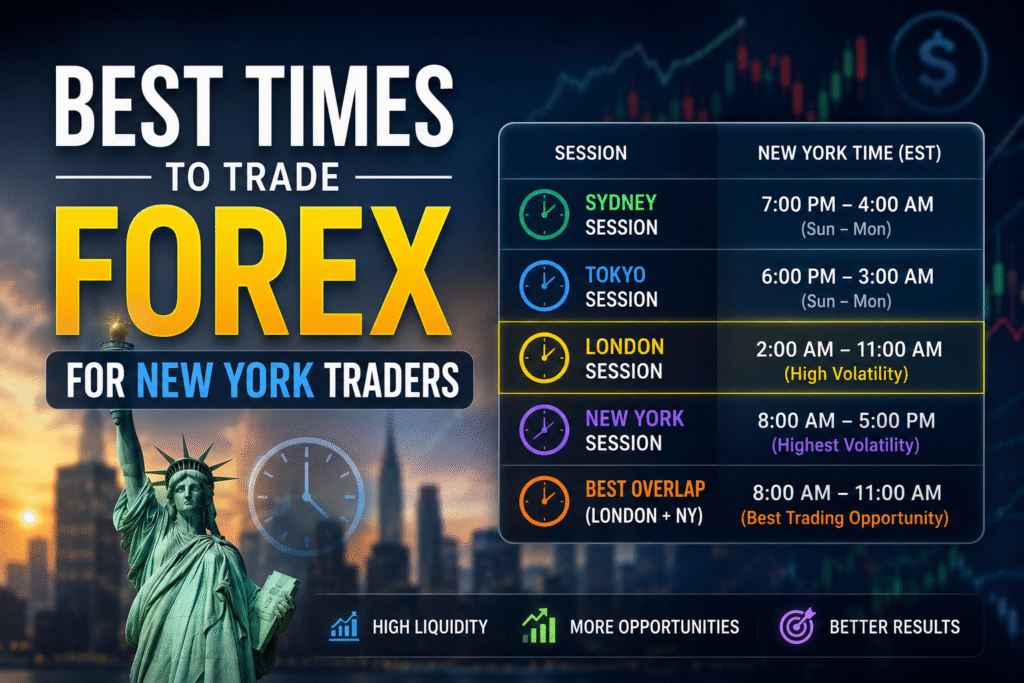
Understanding the Global Forex Market Sessions
The forex market is an over-the-counter (OTC) network. There is no central exchange building. Instead, it’s a massive web of banks and financial institutions spread across the globe. When one major financial center closes for the day, another one opens. This creates a continuous loop of trading activity.
The Four Major Trading Sessions
To get your timing right, you need to know the four main sessions that drive global volume:
1.The Sydney Session (7:00 PM – 4:00 AM EST): This kicks off the trading week. It’s the smallest of the major sessions, so liquidity stays relatively low. It’s a quiet time for major pairs, but you’ll see action in AUD and NZD crosses.
2.The Tokyo Session (8:00 PM – 5:00 AM EST): Traders usually call this the Asian session. Japan, China, and Singapore come online here. Price action tends to consolidate, meaning markets often range rather than trend before Europe wakes up.
3.The London Session (3:00 AM – 12:00 PM EST): This is the biggest session of them all. London handles roughly 35-40% of all daily forex volume. When London opens, volatility jumps, and daily trends usually start forming.
4.The New York Session (8:00 AM – 5:00 PM EST): The second-largest session puts the US Dollar center stage. Since the USD is part of 80% of all forex trades, this window is critical for almost every trader.
Every session has its own specific rhythm, from Tokyo’s tight ranges to London’s aggressive trend-setting.
The Power of Overlaps: When Volatility Peaks
If you want to find the best times to trade forex, look for the overlaps. An overlap happens when two major sessions run at the same time. During these specific hours, the number of active traders doubles. That means higher volume and much tighter spreads.
Key Overlap Periods (New York Time – EST)
| Overlap Period | Sessions Involved | Time Window (EST) | Market Sentiment |
| London-New York | London & New York | 8:00 AM – 12:00 PM | Extreme volatility; highest volume of the day. |
| Tokyo-London | Tokyo & London | 3:00 AM – 4:00 AM | Early trend shifts; moderate liquidity. |
| Sydney-Tokyo | Sydney & Tokyo | 7:00 PM – 2:00 AM | Quiet, range-bound trading; focus on JPY/AUD. |
For anyone trading in New York, the London-New York overlap is the absolute best time to be at your desk. Industry data shows this four-hour window sees more price movement in major pairs like EUR/USD and GBP/USD than the rest of the day combined .
The London-New York overlap is widely considered the best time to trade forex because the world’s two largest financial hubs are active simultaneously.
Why the London-New York Overlap is Prime Time
Best Times to Trade Forex: If you only have a few hours a day to trade, pick these four hours. The reasons come down to institutional money and economic data.
1. Unmatched Liquidity and Tight Spreads
When London and New York are both open, the market is incredibly deep. You can enter and exit trades without causing the price to slip. For retail traders, this means tighter spreads, which keeps your trading costs low.
2. High-Impact Economic Releases
Most of the news that actually moves the market happens during this overlap. Think US Non-Farm Payrolls (NFP), Consumer Price Index (CPI) data, and European Central Bank (ECB) rate decisions. These events act as fuel for massive price swings.
3. Institutional “Fixing”
The “London Fix” hits at 11:00 AM EST (4:00 PM London time). This is when large corporations and central banks push through massive currency conversions. You’ll often see a sudden surge in volume and a final push in the daily trend before the London desks close up.
“The overlap between London and New York is where the real money is made, as it provides the liquidity needed for institutional-grade moves.” — Mk Trader Hub Expert Insight – Best Times to Trade Forex
Volatility by Day of the Week: When to Step Back
Timing isn’t just about picking the right hour. You also need to pick the right day. Just like the daily sessions, the days of the week have their own patterns.
The Mid-Week “Sweet Spot”
Historical data proves that Tuesday, Wednesday, and Thursday are the most volatile days. Economic calendars are usually packed mid-week, and traders have had Monday to figure out the market’s direction.
| Day | Volatility Level | Best Strategy |
| Monday | Low to Moderate | Waiting for trend confirmation; avoid “Sunday gap” traps. |
| Tuesday | High | Trend following; breakout trading. |
| Wednesday | High | Managing “Swap” rates; news-driven volatility. |
| Thursday | High | Continuation trades; often the peak of the weekly trend. |
| Friday | Moderate (AM), Low (PM) | Taking profits; avoid holding over the weekend. |
The Friday Afternoon Trap – Best Times to Trade Forex
A lot of New York traders make the mistake of forcing trades late on Friday. By 2:00 PM EST, London is closed, and US bank desks are packing up. Liquidity dries up fast. The market either goes completely flat or gets erratic. Professional traders usually close all their intraday positions by noon on Friday so they don’t hold risk over the weekend.
Smart traders focus on mid-week volatility and stay out of the market during the low-liquidity hours of Monday morning and Friday evening.
Tailoring Your Strategy to New York Time (EST)
Living in New York gives you a massive natural advantage. You are in the same time zone as the world’s second-largest financial center, and you can trade the London close without waking up in the middle of the night.
The New York Trader’s Daily Routine – Best Times to Trade Forex
If you want to trade like a professional, your schedule should look something like this:
•7:00 AM – 8:00 AM: Pre-market prep. Check the news from the London session and look at the economic calendar for upcoming US releases.
•8:00 AM – 11:00 AM: Active trading. This is the core of the London-New York overlap. Execute your main setups here.
•11:00 AM – 12:00 PM: The London Fix and close. Watch for sudden reversals or final trend extensions.
•12:00 PM – 1:00 PM: Lunch break. Volatility usually drops off as London traders head home.
•1:00 PM – 4:00 PM: Afternoon New York session. Focus on USD-driven moves, but keep your position sizes smaller due to lower volume.
Practical Scenario: The “Morning Breakout” – Best Times to Trade Forex
Here is what actually works in practice. A New York trader sees that EUR/USD has been stuck in a tight range during the Tokyo session. At 8:30 AM EST, US Retail Sales data comes out better than expected. Because this happens during the overlap, the sudden volume pushes the price right through the resistance level. The trader enters a “buy” order, riding the momentum created by both sessions participating at once.
For New York residents, the most profitable hours of the day line up perfectly with a standard morning routine.
Deep Dive: Currency Pair Volatility by Session
Not every currency pair moves the same way at the same time. To get the best results, you have to match the pair to the clock.
Major Pairs and Their Peak Times | Best Times to Trade Forex
•EUR/USD & GBP/USD: These peak during the London-New York overlap (8:00 AM – 12:00 PM EST).
•USD/JPY: You’ll see the most action during the Tokyo session and right at the New York open.
•AUD/USD: High activity hits during the Sydney and Tokyo sessions, usually reacting to Chinese economic data.
Average Pip Movement Comparison – Best Times to Trade Forex
Based on 2024-2026 market averages :
| Currency Pair | Tokyo Session (Pips) | London Session (Pips) | New York Session (Pips) |
| GBP/USD | 60 | 110 | 95 |
| EUR/USD | 50 | 90 | 80 |
| USD/JPY | 70 | 65 | 75 |
| GBP/JPY | 90 | 130 | 115 |
The data shows that the London session consistently gives you the highest pip range for European crosses. The New York session is a close second, especially for USD-based pairs.
“Trading a pair during its ‘home’ session ensures you are participating when the most relevant fundamental data is being priced in.” — Mk Trader HUb Educational Guide
Leveraging Mk Trader Hub for Timing Success
Knowing the right times is only half the battle. Having the right tools to execute your trades is what separates amateurs from professionals. Mk Trader HUb acts as a central hub for traders who want to master these specific windows.
Why Community and Tools Matter – Best Times to Trade Forex
1.Real-Time Alerts: Mk Trader HUb sends notifications right before major sessions open or when high-impact news is about to drop.
2.Sentiment Analysis: During the London-New York overlap, market sentiment can flip in seconds. Mk Trader HUb helps you see whether the big institutional money is buying or selling.
3.Strategy Backtesting: You can use their platform to test how your specific strategy would have performed during different session overlaps over the past few years.
When you combine the community insights from Mk Trader HUb with a strict timing schedule, you take a lot of the emotional stress out of trading. You don’t need to stare at charts 24/5. Instead, you just show up during the hours where the math is in your favor.
Mk Trader HUb helps traders shift from a reactive mindset to a proactive one by supplying the exact data needed to trade peak hours.
Best Times to Trade Forex 2026
To actually make money, you need to understand the “why” behind the volume. Here is a look at what institutional traders are doing during these peak times.
The Role of Market Makers
Market makers (the massive global banks) are highly active during the overlaps because they can easily offset their risk. If you try to push a large trade during the “dead time” between the New York close and Sydney open (5:00 PM – 7:00 PM EST), you will get hit with massive spreads and terrible slippage.
Precision Over Persistence
A lot of beginners think that sitting at the screen for 12 hours a day equals more profit. The opposite is usually true. Expert traders focus entirely on “High-Probability Windows.” They might only trade for two hours a day, but they do it exactly when the London-New York overlap is peaking. Real expertise means knowing when not to trade just as much as knowing when to click buy or sell.
Trust and Transparency
It is crucial to understand that while the best times to trade forex give you more opportunities, they also bring higher risk. Volatility cuts both ways. A news release can hand you 100 pips in profit, but it can just as easily take 100 pips from your account. That is why timing means nothing without a strict risk management plan.
True expertise in forex isn’t about winning every trade; it’s about showing up when the market has enough liquidity for you to manage your risk properly.
Risk Management During Peak Hours – Best Times to Trade Forex
Best Times to Trade Forex : High volatility demands high-level discipline. When you trade the London-New York overlap, you are stepping into the most aggressive financial environment in the world.
1. The “News Gap” Rule
Never open a new trade five minutes before a major news release like NFP. The spread will widen so fast that your broker might stop you out before the actual price move even starts. Wait for the initial crazy spike to settle down, and then look for a safer secondary entry.
2. Adjusting Stop Losses
If you are trading a quiet Tokyo session, a 10-pip stop loss might work fine. But during the London-New York overlap, the market can move 10 pips in a single second just from normal noise. Professional traders usually widen their stops and cut their position sizes in half during these hours to avoid getting chopped up.
3. The Daily Loss Limit
Because the market moves so fast mid-week, it is incredibly easy to “revenge trade” after taking a loss. You need a hard limit. Set a rule—like stopping for the day if you lose 2% of your account—and actually walk away if you hit it. The market will be there tomorrow.
“Protecting your capital is your only job as a trader. The market provides the profit; you provide the discipline.” — Mk Trader HUb Risk Management Philosophy
Conclusion: Timing is Everything in Forex
Becoming a profitable trader takes time, but mastering the clock is one of the fastest ways to improve your results. For New York traders, the game plan is straightforward: focus all your energy on the London-New York overlap, trade mostly mid-week, and use the tools at Mk Trader HUb to stay sharp.
When you align your entries with the best times to trade forex, you trade with the momentum of the market. You get tighter spreads, cleaner trends, and the backing of institutional volume. The market doesn’t care how many hours you work. It only cares about the quality of your decisions during the hours that actually matter. Fix your schedule, respect the volatility, and join a community that helps you grow.
Key Takeaways – Best Times to Trade Forex
•The Golden Window: The London-New York overlap (8:00 AM – 12:00 PM EST) is the single most profitable time for New York traders.
•Mid-Week Momentum: Tuesday through Thursday consistently offer the highest average daily pip ranges.
•Liquidity is King: Trading during peak overlaps guarantees tighter spreads and much better order execution.
•Pair Matching: Trade European pairs during the London session and USD pairs during the New York session to maximize your edge.
•Professional Support: Use Mk Trader HUb for real-time alerts, community backing, and advanced backtesting tools.
FAQ Section – Best Times to Trade Forex
Q1: Can I trade forex on the weekends?
A1: No, the retail forex market is closed on Saturdays and Sundays. It opens on Sunday at 5:00 PM EST (Sydney open) and closes on Friday at 5:00 PM EST (New York close).
Q2: Is it a bad idea to trade during the Tokyo session?
A2: Not at all. It is less volatile than London, which makes it great for range-bound strategies. It is also the ideal time to trade pairs that include the Japanese Yen (JPY).
Q3: What exactly is the “dead zone” in forex?
A3: The “dead zone” usually hits between 5:00 PM and 7:00 PM EST. This is the quiet gap between the New York close and the time Sydney and Tokyo get fully up to speed. Spreads get very wide here.
Q4: How does Daylight Savings Time change these trading sessions?
A4: Since different countries change their clocks on different dates, the session overlaps can shift by an hour twice a year. You should always keep a market clock tool open on your desktop.
Q5: Why do traders keep mentioning Mk Trader Hub?
A5: Mk Trader Hub is an active community and platform that gives traders the tools they need to survive the market. They provide expert analysis, risk management software, and a place to learn from other active traders.
